Learn
06 August 2026 3 min read
What your dog's nose is actually doing
Sniffing is not a delay on the walk. It is the walk, and the research on what it does to a dog's mood is worth reading.

06 August 2026 3 min read
Sniffing is not a delay on the walk. It is the walk, and the research on what it does to a dog's mood is worth reading.
A golden retriever with its head lowered into green grass, nose down, sniffing the ground
Most of us walk dogs as though distance were the point. The dog disagrees, stops at a gatepost, and reads it for a minute and a half. The dog is right.
A dog's nose carries somewhere in the region of two to three hundred million olfactory receptors, against roughly five or six million in ours, and devotes a far greater share of brain tissue to making sense of what they report. The gap is not a matter of degree so much as of kind.
Dogs also sample the world in stereo. Each nostril draws air slightly independently, so a dog can tell which side a smell arrived from and follow a gradient the way we follow a sound. And the air they breathe out leaves through the slits at the sides of the nose, angled backwards, so the outgoing breath does not disturb the scent still being drawn in. It is a one-way system, engineered.
Alongside it sits the vomeronasal organ, a separate piece of equipment above the roof of the mouth that reads the chemical signals other animals leave behind — which is roughly what a dog is doing during the long, still pause at a lamp post.
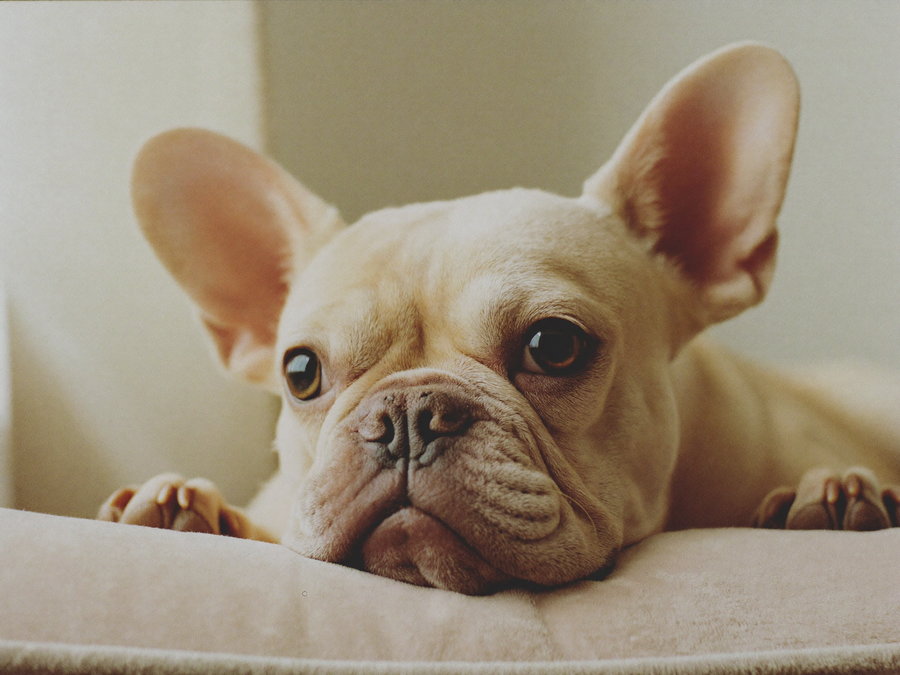
Scent hounds carry more olfactory surface area than most breeds, and a Bloodhound's long ears and loose facial skin genuinely help, sweeping ground scent up and holding it near the nose. At the other end of the range, flat-faced breeds have compressed and folded turbinates, which is one of the less discussed costs of that skull shape.
Scent work is cognitively demanding in a way that walking simply is not, which is why twenty minutes of searching will settle a dog that an hour of brisk lead-walking leaves wired. Anyone who has done a nosework class has watched a whole room of dogs fall asleep afterwards.
There is also evidence that it changes mood rather than just energy. Researchers in canine cognition have tested pet dogs on judgement-bias tasks — an established way of asking whether an animal is approaching ambiguity optimistically or pessimistically — and found dogs given regular scent-work behaved more optimistically afterwards. Letting a dog use their nose appears to make them a slightly more hopeful animal.
The walk you think is boring — same route, same hedges, same gateposts — is a completely different text every day to the animal reading it.
 Behaviour
 Genetics
 Breeds
Made from the same thinking
We only make a thing once we can explain why it helps. Take the fit quiz and we will tell you what to skip.
Furlet Official
A welcome gift
Scratch the foil to reveal your code.